Showing posts with label edible landscaping. Show all posts

Sunday, January 25, 2015

Identify Gardening Goals for Seed Selection

Right now is a really fun time: it's seed selection time! These frigid days are perfect for curling up with a cup of hot chocolate or tea, a big stack of seed catalogs, and a highlighter. My big problem is succumbing to the siren call of full-color photos and poetic descriptions and buying way more seeds than I can fit into my small garden, or attempting to grow things that will never work for me.

If you also fall prey to this, identify your goals in gardening. That way you'll make sure you get just what you want out of your garden. There are lots of reasons to garden, and each one requires different things. Here are some common considerations or goals in gardening that can help you narrow down your seed selection.

Trying to grow as much food as possible; severely limited grocery budget. For many people, the constant rising of food prices has put a strain on the family budget. It's hard to buy high-quality, super-fresh produce when you are barely scraping by. If you are on a limited budget, your goal in gardening will be to grow as much food as possible to prevent buying as much as possible. When you are looking through seed catalogs, look for the following keywords: prolific, highly productive, grows fast, reliable, high yields, second harvest, long harvest. These words indicate that you should get good harvests. When looking for lettuce seeds, look for loose-leaf instead of butterhead or head lettuces. These ones can be picked over several weeks as needed, first as baby greens, then as full-sized leaves whereas other types are typically a one-harvest plant. Pick varieties that are well-suited for your zone. While you may get a harvest from something that does best in a different climate, you'll have lower yields. In some cases it may be worthwhile, but you are sacrificing a good harvest for a small one for the same space in your garden. If you see that something is an heirloom for your state and it says it gives high yields, your chances of a bumper crop are great. Chose indeterminate tomatoes rather than determinate (the former gives a larger harvest over a longer period) and pole or runner beans instead of bush beans (bush beans give one big harvest, whereas runner and pole beans give fair harvests, but over a long period so you get much more per plant). For things that give a harvest over a longer period, such as indeterminate tomatoes, peppers, okra, loose-leaf lettuce, or beans, look for the shortest days to maturity time-frame so you start getting a harvest as soon as possible and continue harvesting until frost.

You're a foodie. If you consider yourself a foodie, then flavor and texture are highest priority, perhaps above yield and ease of growth. Look for keywords like: best flavor, delicate texture, high quality, slow to bolt. Homegrown tomatoes are a completely different thing than anything a grocery store sells, so this is a no-brainer. Other items are also worlds different than their store-bought counterparts: greens, carrots (The first time I tasted a homegrown carrot I realized that I'd never actually eaten a carrot, only orange cardboard impostors!), okra, peas and sweet corn (the second it's picked the sugars start converting to starch so even farmer's market sweet corn won't be as sweet as the stuff you pick while the water is already on to boil). Grow these vegetables that have the greatest difference over anything you can buy.

Milkmaid Nasturtiums are as delicious as they are edible.
Dodging the HOA restrictions. If you have a Home Owners Association that doesn't allow food gardens, or a city that doesn't allow front-yard gardens, but that is your only or best growing zone, you have to be sneaky. Your goal is to grow some edibles, but ones that are pretty enough to look like they were planted exclusively for decorative purposes. You'll do best looking in catalogs with full-color photos simply so you can plan the *cough cough* "flower beds" artistically. Look for frilly lettuces that are red, purple or speckled. Pick things with funky colors that match the overall theme, like Ruby Red Swiss Chard. Some root vegetables can be hidden in between other plants if the tops are pretty: beets, carrots (they really have lovely leaves), even radishes. You make not be able to grow many traditional vegetables like tomatoes, but maybe you can get away with some "ornamental" peppers. These are typically smaller plants with small, vibrantly colored peppers. In my experience, the peppers don't taste as good as uglier varieties, but they are edible, and in the right applications (mixed into chili or pickled in a flavorful brine) might be good enough. Look through the flower selections for "edible" or "medicinal" listed in the description. I grow lots of nasturtiums in my front garden. They are lovely beyond words and the flowers, leaves and seedpods are all edible. Scarlet Runner beans have elegant red flowers that attract hummingbirds; the green beans are really just a side benefit.
This speckled lettuce is pretty enough for the front garden.

Optimum Nutritional Benefits. If your soil is good, pretty much anything you grow will have better nutrition than the weeks old stuff you find at the grocery store. However, some items are going to be nutritional powerhouses compared to lightweights. For example, grow vibrant leafy vegetables like spinach, red lettuces, Rainbow Swiss chard and purple kale instead of iceberg. In fact, don't grow iceburg ever. It is low nutrition, low flavor and gives a smaller yield for the space. Try growing the new variety Indigo Rose tomato as it is rumored to be one of the most nutritious tomatoes in the world and I've never seen it for sale. In general, the most nutritious vegetables are cruciferous (broccoli, kale, brussels sprouts, mustard greens, turnips), green leafy vegetables (in addition to the cruciferous greens: spinach, lettuce, parsley), alliums (especially garlic, leeks, scallions) and tomatoes. Low scores go to iceburg lettuce, radishes, cucumbers and celery.

Food preserving. If you are an avid food preservation artist, you likely want to grow a garden that you can put up into lovely pickles, jams, vegetable chips and other goodies. To be able to preserve food at the peak of freshness, you need to have enough of a harvest to put up a batch from one or maybe two day's harvest. Look for determinate tomatoes as these put on a larger harvest just once whereas indeterminates give several smaller harvests over a long period of time. Look for bush beans over pole or runner beans for the same reason. Look specifically for pickling cucumbers over slicers or salad cucumbers; these have lower moisture and hold up better for longer-term storage.

Garlic scapes are delicious and fun!
Want to try new food. If you want to just try new foods that you can't find at the grocery store, the world is your oyster. Keep in mind your zone, space and soil, but have fun. Look through the catalogs looking for funky shapes, odd colors and vegetables you've never seen. Look through seed catalogs that offer heirloom varieties for the best selection. Some catalogs offer both hybrid and open pollinated varieties, and these will likely have selections that are very similar to what you'll find at your grocery store or have grown in the past. Some of my favorite catalogs for finding new varieties are: Southern Exposure, Seed Savers and Baker's Creek. Baker's Creek is by far the best place to start if your goal is to grow new vegetables and varieties. Their offerings are beyond comprehension.

Want to eat fancier than you can afford. If you are able to afford a healthy diet but of the most basic kind, but want to try exotic, fashionable items, you're in luck! A lot of fancy foods can be grown easily at home. When you are at the market (or just thinking back to when you were), look out for the really high-ticket items. Grow those. Don't grow items that are cheap to buy, even at high quality. For example, zucchini and summer squash are relatively cheap when in season, so don't bother growing those. Cucumbers are also cheap. Grow hardneck garlic (plant in autumn). Not only are there lots of beautiful and tasty varieties, but hardneck (opposed to softneck) varieties send up a scape in late spring or early summer. These exotic beauties sells for $6 for a bundle of 5 at my market. They are out of this world: mild garlicy flavor but crisp and perfect for quiche, stir fry or soups. Edible flowers are expensive, but can be grown easily; look for Nasturtiums, marigolds, chrysanthemum, carnations, sunflowers, day lily, and pansies. Baby carrots are costly per pound compared to larger carrots, but easier to grow than larger ones. Look for Little finger, Babette,  Romeo, Thumbelina, an parisienne. Any vegetables that you like as a "baby" version can be simply picked early: carrots, radishes, greens, and beets. You can even thin every other plant in rows and eat the thinnings while allowing the others to continue growing. When growing greens, whether salad or cooking, look for varieties that you've never seen at the grocery store: dinosaur kale instead of Curly, tatsoi or mizuna instead of bok choi, ruby streaks mustard instead of southern giant curled. Tomatoes are a few dollar a pound minimum. You can also get a large yield per square foot (especially if you grow an indeterminate variety). Grow cherry tomatoes or fun colored tomatoes for the greatest cost savings, rather than run of the mill Romas or beefstakes.
Watermelon radishes are striking and a
fun surprise to cut open.

Teach children about food/healthy eating. If your goal is to get children excited about growing (and eating!) real food, look for fun varieties. Instead of plain orange carrots, look for purple, red or yellow ones. Grow watermelon radishes for their lime green exteriors and hot pink interiors. Look for terms such as: reliable, grows in wide range of soils, predictable, disease resistant. These make it more likely that your child will experience encouraging success instead of defeat.  If you have kids (or partners) who are picky eaters, you can grow things that can help get around the objections. Perhaps kids would be okay with eating neon green tomatoes (for TMNT fans call the slimy interiors "mutagen ooze") or purple carrots or tiny lemon cucumbers when they would be squeamish about the traditional counterparts.

Crystal Apple cucumbers are perfect
mini-sized treats.
Small space/container/indoor. If you are severely limited in your space whether due to having a small garden or needing to plant in containers either on a patio or indoors, you need to look for different varieties than you would if space was not an issue. Look for the following keywords: mini, baby, patio, container, short, compact. Certain vegetables grow better in containers than others. For example, you can grow squash in a container, but not well. Greens on the other hand do fantastically. If you decide to grow carrots in a container, look for shorter ones and especially for mini or baby carrots. For containers, grow "patio" or at least "determinate" tomatoes as these are likely to do better than the massive, sprawling indeterminates (I've had some indeterminates get over 10 feet tall in the garden). If you have a small garden, look for pole beans, indeterminate tomatoes, and climbing cucumbers and put up cages, fences, lines and poles for them to climb up. A single pole bean plant will produce more beans than a bush bean, but it needs room to climb.

Frugal gardening. If you have very little money to start your garden, look for basic varieties from cheaper sources. Dollarseed.com offers a smaller, but thorough selection of seeds at $1 a pack with $1 shipping. They are good quality, but not terribly exciting. That's okay if you're just trying to get started on the cheap. In most seed catalogs, the more common seeds sell a little cheaper than the fancier kinds. Don't diversify too much. While diversity is great, it can also be expensive. So while it would be fun to grow 10 varieties of tomatoes, it would also require buying ten packets only to use a few seeds from each. Instead, buy one or two packets and perhaps save the extras for next year (when you buy two more varieties). Get one or two lettuce varieties instead of a dozen. If you must have variety, it can be worthwhile to buy variety packs/salad mixes instead of several different packs. Do know, however, that these usually cost more and have fewer seeds, so if you are growing a lot, it can be more costly than buying a few different varieties. You can also split seed orders with family or friends to get more varieties while saving money on seeds and shipping. Chose open pollinated versus hybrid varieties and save your own seed so eventually you don't have to buy any seeds.

Before placing your order, do a search for "vegetable varieties" or "heirloom vegetable varieties" and your state to get an idea of what varieties grow best in your region. Identify the number of days in your growing season and make sure any varieties you chose not only will grow during that time-frame, but add a bit of a buffer just in case (my shady yard adds a good week or two til harvest for tomatoes).

By identifying you gardening goals before you place your seed order, you can ensure that you get what you want out of the garden. A little planning can be the difference between a disappointing chore and a fantastic, exciting adventure.

Daylilies are edible, pretty and grow easily.

Saturday, July 19, 2014

The Garden Experiments Update

I love experimenting in the garden. It's the greatest joy to garden, especially when I get to try new ideas. It starts with a "hmm, wonder what would happen if..." and then I start experimenting. I have a challenging yard for gardening: shade, clay soil, and crowding. I've mentioned both on this blog and on social media some of the experiments that I'd either started or wanted to start. Some are great successes, and some wild failures. I thought I'd post some updates and let you know what I'm learning. I'll definitely give more details as the season progresses, but this stuff is so exciting, I wanted to share it with you all ASAP.


The Indoor Winter Paradise. Over this past winter, I grew lettuce indoors. I wrote a detailed piece on it here. To sum up: I planted 6 containers. One was a tiny container with 6a single Black-Seeded Simpson lettuce plant. It was cute, to be sure, but a waste of space. Next year, I'm sticking to 6" containers or bigger. 2 were planted to spinach, and 3 more to red sails lettuce and endive. I planted the last 5 heavily. The spinach never grew large, but the tiny leaves were wonderful in salads. However, the two containers barely produced any real bulk, and so this coming year I will not plant more spinach indoors. The lettuce and endive containers were incredible. We ate loads of salad all winter long. A thorough harvest of the containers was enough for 2 large side salads. I will definitely do this again every. single. year. There is no better way to beat the doldrums of a bleak winter than to harvest a fresh salad. Seriously, though.

The Senior Citizen Peppers. Last year I heard about overwintering peppers and so I decided to give it a go. I'd only got 1-3 peppers per plant last year, so I figured I had nothing to lose. I chose the best two Jimmy Nardello peppers I had last year: the one that gave me the first pepper (although only the one) and the one that gave me the most (3). I dug out about 8" from the stem and plopped the plant into a medium-large container. I filled it in with earth and reused potting soil. When I first brought them in from the crisp autumn air to the warm indoor climate, they exploded with new growth and flowers. I didn't want them to pucker out, so I picked off all of the flowers so they wouldn't put energy into producing fruit. I put them into an area that got some indirect light, but no direct light. It was by a leaky window, so it was cool, but not freezing. After a couple of weeks, they dropped some of the leaves and went dormant. I watered them every week or two but didn't give them any food. Then, in spring, quite on their own, they vamped back up. Lots of new growth and flowers, so I moved them to an area with some good light. I picked off all the flowers so they could focus on growth for now. I planted them out into the garden the same day as my first-year transplants. Now, several weeks later, the results are in. First year plants: 1 of 7 has two small peppers, the rest have flowers only or nothing at all yet. Overwintered plants: I've already harvested 5+ full sized peppers (unripe, but huge) from each plant. Some readers have said you can overwinter a plant for several years. I'll definitely do this again every year.

The Pairing. Tomatoes and Pole Beans. Last year, I planted my Scarlet Runner Beans next to my tomatoes. They kept going off their trellis and onto the tomato plants. At first, I tried to put them back on the trellis, then just let them go. The bright red flowers looked beautiful next to the rich green of the tomato plants and they seemed happy enough together. This year, I picked some pole beans to plant with my tomatoes intentionally. I picked Dean's Purple Podded Pole Beans so I could see the beans among the leaves for easy harvest. I planted 4 beans around the tomato cage. The beans grew up the cages, then over to another cage, then out, then dropped down to lower on a cage, and back up. They are all over the tomato plants. The flowers and stems are a lovely purple and it looks incredible. I have no pole beans yet, but lots of flowers, so hopefully soon. Of the 8 tomato plants with beans growing around them, 5 have tomatoes and loads of them. 3 do not have any tomatoes or flowers yet, but they are the plants in the back and in the shadiest part of the bed (remember that I have little full sun, and this affects my garden a lot), so I assume that the shade is the cause, and not the beans. I will update as the harvest season arrives.


The Perpetual Lettuce Bed. I dug up an overgrown, ugly area of the yard. It is shaded by a big tree in the neighbor's yard. I want it to become a perpetual lettuce bed. For this year, I planted a lot of random things: broccoli (all eaten by bugs), cauliflower (all eaten by bugs), spinach (disappeared overnight), cilantro (spotty germination), pak choi (all eaten by bugs), mustard greens (fantastic harvest that has lasted months so far), summer squash (loads of flowers, but no fruits yet), beans (no germination whatsoever, but they were old seeds). Now, I have some radishes and lettuce planted in some of the spaces where other things had failed to grow. The radishes seem fine, but the lettuce had a poor germination. I think the giant tree that shades the entire area may be responsible for the spotty germination, as the plants that have done okay are farther from the tree. There are some tomato and pepper plants that volunteered from the homemade compost I dumped on last autumn (black soldier flies turned that batch into a horror-show of writhing, so I dumped it out for the birds to feast on...it was terrifying, really). The tomatoes have fruited and the peppers have flowers. There are a lot of weeds, but I've been removing it as I go. This winter, I plan to dump on some compost and loads of leaves and plant it to lettuces in early spring. For this year, I've gotten some food and hope to get a little more, but it is not wildly successful. I do have hope that it can grow something, and I'm not giving up on it quite yet. If next year the germination is pathetic, I'll just sow it to something like mint and let it go wild.

The Decorative Container Garden. I decided that for the front garden, in the area between the sidewalk and the street, I wanted to put some large containers planted to pretty edibles. I decided on Burgundy Okra as the thriller based on it's rich stems and fruits, milkmaid nasturtium as a spiller, and freckles lettuce as the filler.They were not as brilliant as I expected. It's a boring planting really, and just didn't work out as I'd planned. The okra falls over without support. The nasturtium variety I picked is bushy, not spilling like I'd read online (What? Not everything you read on the internet is truth???). The freckles lettuce is an effective filler. One planting gets a bit more sunlight and is much bigger. The okra plant already has fruited. The nasturtiums are in bloom. The lettuce is wicked big and I'm harvesting enough for two-side salads every day. The other planting? The okra hasn't flowered yet. The nasturtiums failed to germinate the first time, and there's only one flower. The lettuce is much smaller and I've had to plant in a lot of Black-Seeded Simpson lettuce to try to fill it in a bit (that's all the lettuce seed I had left). The second planting is under a tree, so it get's less sunlight, and I think more rain since it is right under a branch end. It is often flooded (Yes, I need to drill a couple holes). I'll keep trying at edible landscaping, but this planting does not work.

The Pea High Chair. I have an old wooden chair I dumpster dived. It's wobbly but pretty. I imagined it covered in pea vines. I plopped it in the garden and planted peas all around it. I planted spinach underneath it, thinking that since spinach bolts easily, maybe the shade from noon-sun would protect it. The peas germinated well and looked great. And then....then the groundhogs came in. They ate them down, and then we'd attempt to repel them with airguns, solar-powered high-pitched squealing motion detectors, screaming, cursing, and finally, even some organic small-mammal repellent (I believe it was some sort of predator urine). They kept coming back and nibbling the shoots. Sigh. I got a few peas, but that's it. The spinach germinated okay, but died off shortly. Failure. I will not grow peas again at this property. Two years I've planted, multiple times a spring, and the groundhogs or rabbits always get them.

The Hugelbeet-Inspired Bed. There was a low spot in the back yard, so I decided to do a hugelkulture-inspired project. I dug out the sod and top soil, then laid down a bunch of branches and logs. I sprinkled in compost and composted cow manure, then added some leaves then turned the sod upside down on top. I put the top soil on top of that, and added a couple bags of compost. It rested a good 6 inches higher than the rest of the yard. As time has passed, it has shrunk down so it is roughly even with the rest of the yard instead of being 6 inches lower than the surrounding ground. On that count, it is a success. In other ways, it is mixed. I planted beans,cukes and squash on the bed. I know that squash is a heavy feeder, but I had extra seedlings, so there they went. The squash and cukes have flowered, but no fruit. The beans all flowered like mad and have put on a thick set of beans. The leaves on everything are light green and yellow. I think this is simply a matter of it being a first-year bed, and the wood is tying up some nitrogen while it breaks down. Between the aging of the wood, some coffee grounds I've been dumping on it, and my plans to work in the expired bean plants, I think next year will be better. I'm getting a harvest from it, and that's the important thing! There have been a lot of weeds, but I've noticed that in every new bed. I've been faithful at weeding, however, and the stand of weeds has diminished significantly.

The Crowded Room. I have a couple containers in the front garden by the front door overcrowded in an attempt to see just how much I can cram in and still get a harvest. One planter has a tomato plant and an underplanting of radishes and beets. The other has 4 pepper plants and an underplanting of radishes. In the first container, I have a lot of tomatoes. Score. The beets have been sulking and not putting on any growth. The radishes are starting to bolt. I will likely harvest the beet greens for salad and allow the radishes to put on those deliciously crunchy seedpods. In the second container, the peppers look okay and have unopened flower buds so far. I will likely harvest half of the many radish plants to put into salads and see if the remaining plants will bulb up at all.

So what about you? Have you had any fun experiments in the garden?


Shared on:
Homestead Barn HopThe Self Sufficient HomeAcreWildcrafting Wednesday

Monday, April 28, 2014

Growing Food in Less Than Ideal Conditions


A lot of people want to be more involved in producing their own food, but think they can't because they don't have the "proper" setup. Maybe the yard is tiny. Maybe it's shaded or the soil is hard clay. I have a lot of those same issues, but still grow a lot of food. I thought I would share my back yard with you so you can see that even with a challenging property, you can still grow some of your own food.  The photo on the left is of my backyard when we bought the property. It is late summer when this picture was taken. The picture below is the property  in spring before the leaves have really filled out.

My property is 1/5 acre total, about half of that is the backyard. My soil is clay or clay loam depending on the part of the yard. There is also a lot of gravel in the soil, so I try to remove as many stones as I can while digging the bed. Whenever I work in the garden, I remove any rocks I see. Rains expose more over the course of the season, so in a year, I remove a lot.


The property line is all trees, so the perimeter is completely shaded.  There is a huge tree on one side that casts shade over half of the backyard. There is only one section that gets good sun, that's the two horizontal beds . The two vertical beds get partial shade, but enough sun to grow food. I will be digging another bed along the back where the fire pit is now, as that area also gets good sun. One lovely benefit of the treeline: I have 7 mulberry trees, and when in season, after work each day I walk around and pop fresh berries in my mouth as a perfect snack. Can't beat that.


To maximize our sunny areas, Trucker has been thinning out the treeline, removing a couple of medium-sized trees that were in the way. He also ruthlessly prunes back the trees to give me a little more sunlight. While I loved the privacy that the thick stand of trees provided, I like homegrown tomatoes better.

Since I knew what areas got the best sunlight, I planted my sun-lovers in those beds, and used the other beds for vegetables that tolerate a bit of shade. The sunniest beds housed my tomatoes, peppers and eggplants. The partially shaded beds were home to peas, carrots, radishes, spinach and lettuce. Last year, the tomatoes went nuts! We had more than we could eat fresh. I was able to dehydrate several gallon containers worth, which we are just now finishing in late April. I was even able to sell some of the green tomatoes to one of Trucker's coworkers. Even with the limited space, we got a huge harvest.


This area is under a neighbor's tree just over the property line. It casts pretty heavy shade for a lot of the day, but gets some sunlight in the evening. It was overgrown in weeds and just looked bad (left photo). I dug out all of the weeds, dug the bed and worked in some compost. I smoothed it out into a seedbed. I planted it with beans, lettuce, spinach, mustard, swiss chard, onions and sprouting broccoli (right photo). All of these can tolerate some shade, but won't give as good a harvest as if they got more sunlight. Even with a more limited harvest, it's better than nothing, and seeds are cheap enough. Trucker bought me a ton of seeds this year, so I can be free with planting.
A side benefit for the greens is that the shade will keep them from getting so overheated, so they might not bolt as quickly. At my old apartment, I had a 2'x2' bed that I seeded to lettuces. It got only 1-2 hours of sun a day, but grew well and didn't bolt in the summer heat. I had greens from late May through late October.


My soil is clay or clay-loam depending on the area. The areas directly under trees are clay-loam or even loam, which makes sense due to the leaves falling and decomposing into the soil. I do not throw away any yard waste from our property. All leaves are raked and used in mulching or composting. All weeds are either left to dry and then composted (before they've gone to seed) or burned and the ash worked into the soil (if they have gone to seed). Branches and trees are chopped and used in hugelkulture-type projects, or they are burned during one of our bonfires with friends and the ash worked into the garden beds. I sometimes use straight branches as trellises for beans. After mowing the lawn, I allow the clippings to dry for a few days, then rake and store to use as a brown in my compost. In addition, I compost every scrap of organic matter I can-even the weird stuff. Sometimes I take eggshells home from my job at the bakery to make into a great fertilizer for tomatoes to prevent blossom end rot. I've even been known to scoop up bags of leaves from the curb.

Regular applications of compost, manure and mulch can save a bad soil. I already see a difference in my garden beds from last year. They are fluffier and darker than last year. My parents' soil used to be hard clay. We would dig up clay and sculpt with it. After a decade of adding as much organic matter as they can, they have a very nice, productive plot with good, soft, rich soil.

In my lawn, there were a few low areas that allowed water to pool, looked bad and made mowing difficult. To remedy the situation and claim the area as a garden bed, I make a simple hugelkulture-type bed. I dig out the topsoil and put aside. I bury as much woody material as I can in the low area, such as broken up branches or logs. The older the wood the better. Then I sprinkle in some wood ash from the fire pit. If I have some produce scraps or coffee grounds from the kitchen, I work those in with the branches. If you have access to manure, put that in now. Dry grass or chopped leaves go on top of that, followed by the sod, turned upside down to kill out some of the grass (there will still be weeds, but not as many). On top of this, I put the rest of the topsoil as well as some good compost or aged manure if I have it. I pile enough material in that the area is about six inches or so higher than the surrounding area. As the material breaks down, the bed will sink a bit and I want it to sink to be level with the surrounding area.

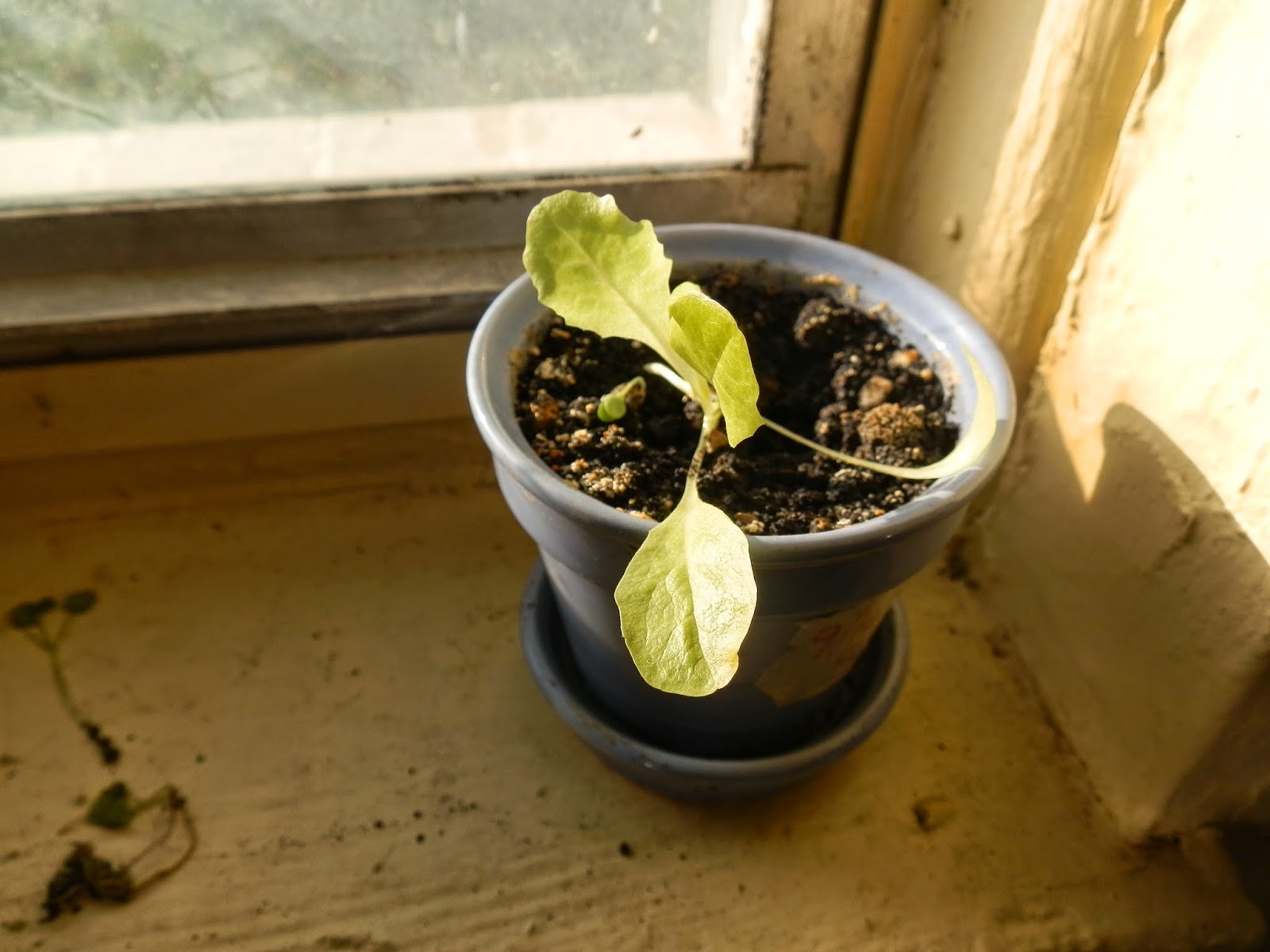
If there is no option of growing outside-say a HOA restriction, renting, apartment living or just in winter, grow indoors! This one windowsill of lettuce and spinach provided some much needed fresh salad during months when we couldn't grow outdoors. We got our first harvest in December and got our last harvest a week ago (Mid-April).

If you have any sunny windows, fill them up with lettuce, pea shoots, cherry tomatoes, green onions, radishes, herbs, spinach, beets and carrots. Even if you have no sunny windowsills, you can sprout beans and seeds in a cupboard.

My house faces south so the front yard gets much more sunlight than the back garden. This year, I'm branching out into edible landscaping. I have chosen several pretty plants that I am going to mix into the flower beds in front. Scarlet Runner beans have beautiful leaves, stunning flowers and attract hummingbirds making them a perfect decorative plant, and I get green beans! Ruffly red and speckled lettuces will fill in empty spots between flowers. Large planters matching the house will hold Burgundy Okra, Milkmaid nasturtiums, and Red Sails lettuce. One will go on each side of the driveway.

Being able to grow your own food is a magical thing. It tastes absolutely incredible, is much fresher than anything you could buy anywhere, and it's incredible to casually mention during a dinner party "Oh, those tomatoes? I grew those."

Shared on:
From The Farm Blog HopHomestead Barn HopThe Self Sufficient HomeAcre13 Heritage Homesteaders Hop #1Simple Saturdays Blog HopStrangers and Pilgrims on Earth

Sunday, May 26, 2013

Food Production with Limited Space

I love gardening. I grew up in a semi-rural area, and have been gardening for as long as I can remember. My parents used to send me to an elderly couple's house to help them with their tomato garden, and to this day, the scent of tomato leaves brings up wonderful memories. When I moved out on my own, I found myself in apartments without yards. For a few years I ached for a yard to grow a garden and thought I'd never be able to unless I could move out of the city. Fortunately, I began experimenting with small-scale gardening.

Here are some tips for those of you in apartments, cities, shaded yards, suburbs with restrictive landscaping expectations or other challenges to your green thumb.

This shaded patch by the front door provided an entire
season's worth of salads. I planted endive, landcress, and
lettuce. Some dandelion poked through, but I let it grow
since it was edible too.
If all you have is a partial shaded spot, focus on lettuce. Lettuce likes cooler weather, so the shade keeps it from overheating and bolting. At my old apartment, there was a patch of dirt by the front door. It got only a couple hours of sun each day. I was tired of it looking so trashy, so I asked the landlord if I could plant it and he said yes! I scattered a few varieties of lettuce seed over the area and hoped for the best. Soon I was enjoying microgreens to supplement my salads, then I was getting all of the lettuce we could eat in salads and sandwiches. Since the area was shaded, it didn't bolt in the hot weather. That little 2x3 foot patch kept us in salad from late May til October. Other plants that may do well in partial shade: broccoli, peas, beets, radishes, beans, carrots, turnips and bok choi.

Plan to keep your garden plot working all season long. Early in the season, get some radishes, lettuce and spinach in. Once that's ready, it will be time for summer crops like tomatoes and peppers. Then as you take out the spent plants, get more lettuce, radishes, spinach and perhaps some kale in. Look for varieties that can withstand snow so you can go out in early winter, brush away the snow and dig out dinner.


By the time the harvest came in, the bean plants were 15 feet
tall and grew to the top of the branches behind the trellis.
The trellis is just a planted headboard I curb-shopped.
Use your space wisely. When planting lettuce, alternate lettuce seeds with radish seeds. Radishes will mature while the lettuce is still tiny and will be harvested before the lettuce needs the space. Plant lettuce, radishes, basil or carrots in between tomato plants to use otherwise wasted space. Grow vertical when you can to make the most of your square footage.

Grow multi-purpose plants. Everyone knows you eat radish bulbs, but the leaves are also edible. Beet and carrot leaves are also edible. When choosing a bean variety, look for one that you can eat immature as a pod,
or as a dry bean (Scarlet runner beans are good for this, and they're beautiful!)

Who can say Romanesco Broccoli isn't beautiful?
If you live in an area with strict rules about landscaping and gardening, mix edibles in with flower beds. Edible flowers are beautiful and add a bit to salads or can be used for fritters. Ornamental kale, swiss chard, or red-leaf lettuces hold their own in a flower bed.

Salad made from thinnings from the
outdoor radish and carrot beds and
from the indoor lettuce pots.


Eat your thinnings. If you have to thin radish, carrot, beat or lettuce, make a salad out of the tiny veggies.

A sunny window is the perfect place to grow
some lettuce for winter salads.
Grow some edibles indoors. I've had mixed success with indoor food gardening, but my failures were really because I was stupid. For example, my first indoor food garden, I used all tiny containers and tried to grow tomatoes and onions in containers that were in no way appropriate. However, even being stupid, I still got lots of green onions, some lettuce and exactly one pea-pod. In later years, I had better luck by choosing appropriate plants and containers. Lettuce, radishes and herbs will grow in smaller containers. If you have the space for larger containers, you can grow a lot of other things, such as tomatoes. Look for "container" or "patio" varieties. Put in a south facing window with lots of sun or get a grow light. Don't forget to water once or twice a day.


If you have a small patio or balcony that gets a bit of sunlight, you are in luck. A lot of great vegetables and fruits can be grown in containers. I've grown tomatoes, peppers, cucumbers, lettuce, onions, radishes, cucumbers, and more in containers in the patio at my old apartment. The south-facing patio got just enough sunlight. I salvaged food-grade buckets from my job at a restaurant for many of the plantings, and used small trash cans that I bought for less than a dollar at a thrift store.

If you have no yard, no balcony/patio/porch, and no sunny windows, you can still grow a bit of food: sprouts. Get lentils, mung beans, or other beans/seeds, soak for 8 hours in water, then drain, rinse and place in a cupboard. Once or twice a day, rinse and drain well. Soon you'll have delicious sprouts to add to sandwiches, salads or stir-fry. It's an easy and cheap way to grow a little food.

Pick wild foods in your area. Dandelion leaves are a deliciously bitter green for salads or steamed to use like spinach, the flowers make incredible fritters or jelly and the roots make a delicious coffee substitute. Violet flowers and leaves are great additions to salads. Red clover flowers make a nice tea. I find lots of edibles growing in the heart of the city, and I take full advantage of them. Fruit trees left over from a more self-reliant time are still dotting the city landscape. Look for mulberries, crab apples (use in jelly or add to other apples when juicing for a bit of zing), and pears growing along parking lot edges or hanging over sidewalks.

Guerilla garden. If you cannot find a place that you are allowed to grow some food, look for a place that you can grow food without anyone noticing. Abandoned lots and empty planters (such a depressing sight!) beg for some green beauty. Take over the flower beds that your landlord has long since stopped planting. A sprinkling of lettuce seeds are easy enough to plant without anyone noticing.

Shared on:

Wildcrafting Wednesday

http://realfoodforlessmoney.com/simple-lives-thursday-175/

Related Posts Plugin for WordPress, Blogger...